Escaping Extermination
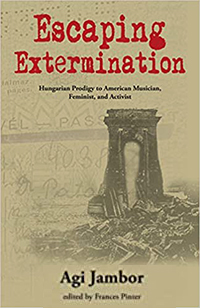 In 2020 Purdue University Press published the memoir written by my great aunt, the pianist Agi Jambor, which I edited and for which I wrote an Afterword.
The memoir is about surviving as a Hungarian Jew in Budapest and narrowly escaping death many times. It ends with human triumph and is an inspiration to all who are struggling with the world we live in today.
Agi Jambor was born in Budapest Hungary in 1909 and died in Baltimore MD USA just a day short of her 88th birthday in 1997. If she’d been a cat she might with some justification have said she’d lived nine lives throughout her eventful life.
Agi Jambor's mother was an accomplished piano teacher. She was a child prodigy at the piano, and when she was in her teens had built such a reputation as a concert pianist in Western Europe that renowned German pianist Edwin Fischer took her on as a favoured pupil in Berlin. However, sensitive from the start to the anti-Semitism around her in German-speaking countries and conscious of the growing threat of violence from supporters of the Nazi party, Agi fled to Paris in 1931 and virtually into exile. Rather than playing in public she scratched a living as pianist in a dance studio.
Here she is after performing her first solo performance at Carnegie Hall in New York in 1949.

Agi Jambor following her solo performance at Carnegie Hall, New York in 1949.
Who was Agi Jambor?
Budapest 1909: Agi Jambor was born into a family with a high vision of cosmopolitan culture. Their ideal: a life devoted to art and the mind. Agi Jambor was a musical child prodigy, and studied with teachers such as Edwin Fischer, Zoltán Kodály and Alfred Cortot. They infused her music with a particular sensibility, which made her into one of the most distinctive interpreters of Bach, Mozart and Chopin of her generation.
After her amazing escape from war-torn Budapest, Agi went on to build a life in America, where she was rapidly asked to perform a piano concert at the White House. She married and divorced the British Hollywood actor Claude Rains (of Casablanca fame) and kept company with Nobel Prize winners. As a sought-after soloist, she played under the baton of Eugene Ormandy and Bruno Walter, and recorded several albums for Capital Records in New York. She then made a career teaching at several universities and conservatories of music.
As a professor of classical piano at Bryn Mawr, a women’s liberal arts college in Pennsylvania, Jambor pioneered ethnomusicology, insisting that a younger generation of musicians had to “live in the music, recreate the music of non-Western peoples, even if they have no spoken words, no ideas to help them”. Her idea was that music could be a way out of a muteness imposed by the trauma of history and dramas of individual lives.
Agi was a feminist and a vocal human rights activist. She took on the FBI in the McCarthy era and protested against the Vietnam War – setting up the Agi Jambor Fund to raise money for food for Vietnamese children.
She lived an extraordinary life, enjoying a creative freedom rare for women of her time. She found true love in her first husband, the scientist Imre Patai, success everywhere she went, and the recognition and satisfaction of being part of the most vibrant artistic and academic circles.
Yet she was also afflicted by tragedy – losing a child, a country, a husband and an idyllic life. Ill health plagued her towards the end of her long life. What makes her story exceptional is precisely this ebb and flow of triumph and disaster, of blessedness and horror. Agi was a small, gutsy, warm-hearted woman who defied the odds and survived to live life to the full.
Marcus Ferrar, 2019
You can purchase the memoir Escaping Extermination from Amazon.com or from Amazon.co.uk
